Skip to content
Positive Discipline in European Schools Positive Discipline
in European Schools
  • Home
  • The project
    • Objetives
    • Target groups
    • Whole School Approach
  • Impact
    • PSLL lesson plans
    • Educational Research
    • Conference
  • Partners
  • Outcomes
  • Upcoming events
  • Forum
  • Contact
Positive Discipline in European Schools Positive Discipline
in European Schools
Menu
  • Home
  • The project
    • Objetives
    • Target groups
    • Whole School Approach
  • Impact
    • PSLL lesson plans
    • Educational Research
    • Conference
  • Partners
  • Outcomes
  • Upcoming events
  • Forum
  • Contact
Implemented activities

5.1 by HU – Article in Szignum school newspaper

ByAttila Gulyás March 17, 2025December 3, 2025

https://szignum.hu/sites/default/files/2025-03/iskola_2025_március.pdf

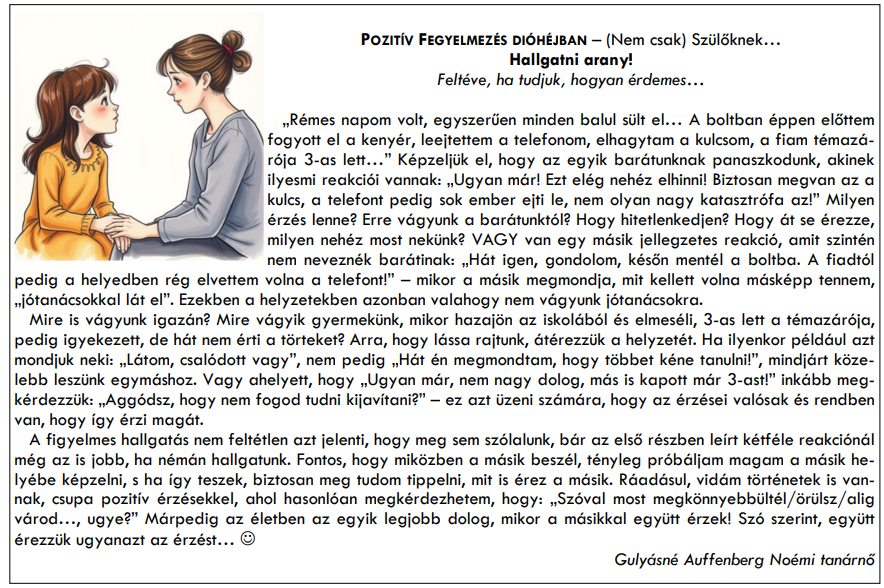
POSITIVE DISCIPLINE IN A NUTSHELL – (Not only) for parents…
Listening is golden!
Provided we know how to do it…
Post Navigation

3.5 – by Hungary – PD Teacher training in Roye

Previous

5.1 – by Portugal – Dissemination in Facebook

Next

Related Posts

2.7 – by BUL: First, an open discussion/workshop on our Erasmus project “Positive Discipline” for parents

February 26, 2024November 27, 2025 Implemented activities

2.1 – by Poland -International inaugural and training conference

June 23, 2025October 30, 2025 Implemented activities

5.4 by Nadine Gaudin –  coverage of the Conference in French

September 11, 2025October 30, 2025 Implemented activities

Positive Discipline in European Schools is a 2-year project, starting from October 1st 2023. It provides a framework for parents, teachers, educators, students and school leaders to familiarise themselves with the theory and practice of Positive Discipline, and develop Personal, Social and Learning to Learn competence.

Useful links

  • PositiveDiscipline.com
  • Positive Discipline Guidelines
  • Social-Emotional Skills
  • Positive Discipline Association
  • Social and Emotional Learning

Funded by the European Union. Views and opinions expressed are, however, those of the author(s) only and do not necessarily reflect those of the European Union or the Tempus Public Foundation. Neither the European Union nor the granting authority can be held responsible for them.

Copyright © Fundação Salesianos
  • Privacy
  • Cookies
  • Terms and Conditions